House on the hill


House on the hill
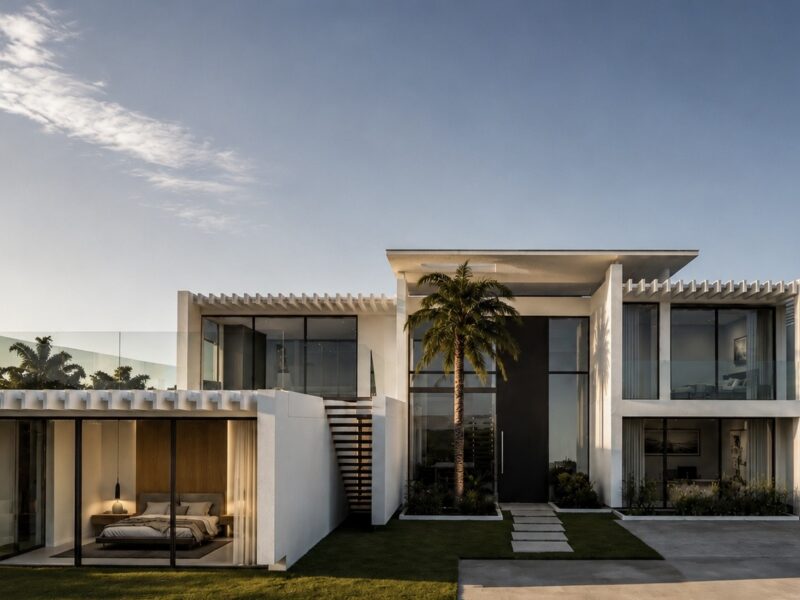
The House on the Hill, set on a 296.66 m² plot with privileged views over the city of Lisbon and featuring 235 m² of construction area, stands as a synthesis between the formal clarity of the Modern Movement and a contemporary sensibility deeply guided by light, materiality, and the relationship with its setting. Its composition is grounded in pure, horizontal volumes, where the refined and lightweight upper floor rises above the timber-clad base, establishing a balanced dialogue between mass and suspension, solidity and visual fluidity.
The essential geometry, defined by rigorous lines and volumetric simplicity, allows the architecture to speak for itself, echoing the modern tradition that values stripped-down form, the transparency of large openings, and the seamless continuity between interior and exterior. The generous opening on the upper floor frames the landscape, transforming light and horizon into living components of the inhabited space, integrating the house into the hillside in a manner that is both subtle and expressive.
Lighting, particularly at dusk, takes on a poetic dimension. The warm glow emanating from within turns the building into an architectural reference in the landscape, enhancing the sense of welcome and spatial depth. The recessed terrace, where a tree is integrated into the main entrance façade, extends the experience of dwelling beyond the constructed limits, creating a hybrid space that oscillates between inside and outside — an ambiguity cherished by the masters of the Modern Movement.
Materiality plays with the contrast between the almost sculptural white surfaces and the warm texture of dark wood, conveying rigor, authenticity, and comfort simultaneously. This combination reduces the architectural presence to its essence — silent, contemplative, and deeply connected to its site — while embracing the technical sophistication that supports its minimalist expression.
Thus, Casa da Colina stands as a piece of contemporary architecture rooted in the principles of the Modern Movement: functionality, formal clarity, transparency, material honesty, and a continual search for dialogue between light, shadow, and landscape. It is a house that gazes over Lisbon, but above all, one that interprets dwelling as a serene, luminous, and sensorial experience.
LOCALIZATION
Loures
YEAR:
In development
ARCHITECTURE:
Nuno Ladeiro / Carmo Branco
COLLABORATORS:
Bárbara Raimundo / Andrea Gonçalves
Category:
Architecture